Trusted by 50,000+ Indians

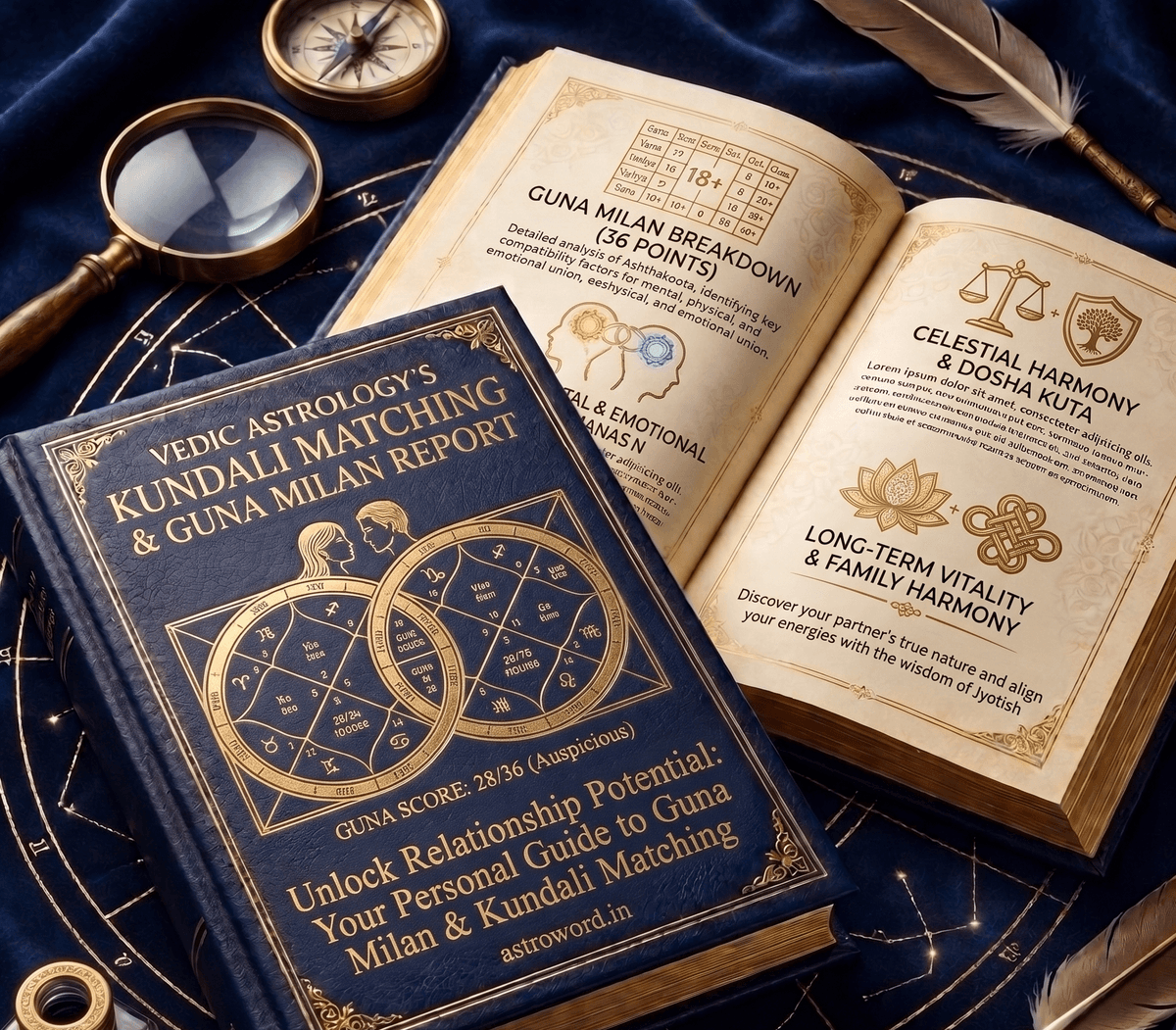
Kundali Compatibility Matching
Enter birth details for both partners to run a full 36-point Ashtakoota Guna Milan, check Jaimini spouse karakas, and verify Manglik alignments.
Kundali Matching — Free Ashtakoota & Jaimini Compatibility Calculator
For thousands of years, Vedic astrology has served as a cosmic beacon guiding couples toward harmonious unions through the time-tested system of kundali matching. Traditionally referred to as Kundli Milan, this sacred method analyses the alignment of planetary bodies at the precise moment of birth to evaluate emotional, intellectual, physical, and spiritual compatibility. At AstroWord, we blend this ancient wisdom with modern precision, introducing advanced parameters like jaimini kundali matching, navamsa kundali matching, and kundali matching with AI to deliver the most comprehensive compatibility assessment available online.
Our calculator goes beyond basic moon-sign matching to evaluate the intricate layers of your birth charts. By incorporating the traditional 36-point Ashtakoota system alongside the profound secrets of Jaimini astrology—particularly kundali matching darakaraka—and the deep inner marriage code of the D9 Navamsa chart, we provide a holistic map of your relationship destiny.
What is Kundali Matching in Vedic Astrology?
At its core, kundali matching is the process of comparing the horoscope charts of two individuals to determine their suitability for marriage and long-term partnership. In the Vedic tradition, marriage is not merely a legal contract or a physical union, but a coming together of two souls on a shared karmic journey. The planetary configurations at birth map out each individual’s personality, desires, challenges, and destiny. When two charts are compared, we can identify where their energies flow in natural harmony and where potential friction points may arise.
The traditional method relies on the position of the Moon in the birth charts of both partners. The Moon represents the mind, emotional responses, subconscious conditioning, and general temperament. Because a successful marriage depends heavily on emotional synchronization and mutual understanding, comparing the Moon’s placement provides a reliable baseline for daily compatibility. However, relying solely on the Moon can overlook critical areas such as physical attraction, longevity, spiritual purpose, and financial stability. This is why a complete compatibility assessment must evaluate additional dimensions, including Jaimini astrology, planetary transits, and divisional charts like the Navamsa.
The 8 Ashtakoota Kootas Explained
The classic North Indian system of Kundali Milan assigns 36 points (Gunas) distributed across eight distinct categories, or Kootas. Each Koota represents a specific aspect of relationship compatibility:
1. Varna (1 Point) — Spiritual & Work Compatibility
Varna represents the spiritual and mental development of the partners, categorised into four groups: Brahmin (intellectual/spiritual), Kshatriya (ruling/protective), Vaishya (commercial/productive), and Shudra (supportive/service-oriented). The system assesses whether the mental and spiritual focus of both partners aligns. A higher or compatible Varna hierarchy for the boy compared to the girl indicates a natural flow of mutual respect, though modern interpretations treat this as an alignment of career values and intellectual temperament.
2. Vasya (2 Points) — Mutual Attraction & Dominance
Vasya determines the natural attraction and power dynamics between the couple. The zodiac signs are classified into five groups: Chatushpada (quadrupeds), Manusha (humans), Jalachara (water creatures), Vanachara (wild beasts), and Keeta (insects). The scoring assesses who will influence or dominate the relationship, ensuring that the power dynamics remain balanced and that neither partner feels overshadowed or controlled by the other.
3. Tara (3 Points) — Health, Destiny & Longevity
Tara measures the relationship between the birth stars (Nakshatras) of the couple. By counting the distance from the boy's nakshatra to the girl's, and vice versa, and dividing by nine, we evaluate the karmic influence on health, prosperity, and longevity. Favorable remainders (Sampat, Kshema, Sadhaka, Mitra, Atimitra) indicate safety and success, while unfavorable ones (Vipat, Pratyari, Vadha) point to obstacles that require patience and remedies.
4. Yoni (4 Points) — Physical & Sexual Compatibility
Yoni compatibility is calculated based on the animal symbol associated with each Nakshatra. There are 14 animal classes representing instinctual temperaments, sexual rhythms, and biological compatibility. A match between friendly animals (e.g., Horse and Elephant) indicates deep biological attraction and physical comfort, while a match between natural enemies (e.g., Cat and Rat, or Snake and Mongoose) can lead to instinctual friction, requiring conscious communication and emotional trust to bridge.
5. Graha Maitri (5 Points) — Mental & Intellectual Friendship
Graha Maitri evaluates the relationship between the planetary lords of the couple’s Moon signs. Friendship between sign lords (such as Sun and Jupiter, or Venus and Mercury) ensures excellent mental compatibility, shared humor, mutual affection, and intellectual alignment. Mismatches here indicate contrasting worldviews, requiring both partners to respect each other's cognitive patterns and choices.
6. Gana (6 Points) — Temperament & Behavioral Rhythm
Gana categorises Nakshatras into three temperaments: Deva (divine/gentle), Manushya (human/pragmatic), and Rakshasa (demonic/intense). Perfect alignment occurs when both belong to the same Gana. A Deva-Manushya union is also highly stable. However, a Deva-Rakshasa or Manushya-Rakshasa union results in Gana Dosha, indicating a clash in emotional response, values, and coping styles during times of crisis.
7. Bhakoot (7 Points) — Emotional Connection & Domestic Happiness
Bhakoot measures the relative distance between the Moon signs of both charts. Auspicious relative distances (trines like 1-5 or 9-5, quadrants like 1-7 or 4-10) promote domestic bliss, joint prosperity, and emotional synchronization. Inauspicious relationships (6-8 or Shadastak, 9-5, and 12-2 or Dwirdwadash) trigger Bhakoot Dosha, which can bring financial ups and downs or emotional distance, though specific planetary friendships can mitigate this.
8. Nadi (8 Points) — Physiological & Genetic Compatibility
The highest-weighted Koota, Nadi represents the physiological constitution (Vata, Pitta, Kapha) of the partners, classified as Aadi (initial), Madhya (middle), and Antya (end). Partners must have different Nadis to ensure biological balance, genetic health, and the well-being of future children. If both share the same Nadi, Nadi Dosha is formed, which traditionally warns of genetic friction, although astrological cancellations apply if their Nakshatras or Moon signs differ.
What Makes Jaimini Kundali Matching Different?
While the traditional Ashtakoota system offers a robust framework for assessing emotional and behavioral alignment, it only represents one dimension of compatibility. To unlock a deeper level of relationship analysis, AstroWord incorporates jaimini kundali matching. Based on the teachings of Sage Jaimini, this advanced system evaluates compatibility using the actual degrees of the planets rather than just sign-based placements.
The primary key to Jaimini compatibility is the Darakaraka. The planet that has the lowest degree in your birth chart (excluding Rahu and Ketu) is designated as your Darakaraka, and it represents the soul signature of your spouse—their appearance, inner nature, temperament, and the lessons they bring into your life. In jaimini kundali matching darakaraka analysis, we evaluate the relationship between the boy's Darakaraka and the girl's Darakaraka, as well as how their Darakarakas interact with each other's Atmakarakas (the planet representing the self/soul).
Additionally, Jaimini astrology utilizes the Upapada Lagna (UL)—the Arudha of the 12th house—to analyze the longevity and commitment of the marriage contract. The Upapada Lagna represents the actual institution of marriage, showing how long the partnership will endure and the degree of worldly support it will receive. Comparing the UL signs of both partners ensures that the couple has the structural compatibility required to withstand external challenges and maintain long-term commitments.
How D9 Navamsa Reveals Deeper Compatibility
The D1 Rashi chart represents your physical life, outer personality, and worldly circumstances. However, in Vedic astrology, the birth chart is incomplete without the D9 Navamsa chart. The Navamsa is the most important divisional chart, representing the inner reality, matching potentials, and fruits of marriage. A couple may show excellent compatibility in their D1 Rashi charts (a high Guna score), but if their D9 charts are severely misaligned, the marriage can experience hidden friction and eventual distance.
In navamsa kundali matching, we analyze three crucial parameters:
- ✦D9 Ascendant Alignment: If the Navamsa Ascendants of both partners are in mutual trines (1st, 5th, or 9th house relationships) or friendly signs, it indicates a strong spiritual harmony and a shared life philosophy that supports the union.
- ✦Venus Placement in D9: Venus is the natural significator (Karaka) of love, physical attraction, and relationship harmony. Checking the sign and house position of Venus in both D9 charts reveals the inner capacity of both partners to give and receive love.
- ✦7th House and 7th Lord of D9: The 7th house in the Navamsa chart indicates the quality of relationship stability and commitment after marriage. If the 7th house contains beneficial planets or the 7th lord is well-placed, the marriage is blessed with resilience and longevity.
Dosha Analysis and Cancellations in Compatibility
During the matching process, specific planetary alignments can create challenges, commonly known as Doshas. The three most significant doshas evaluated in a compatibility audit are:
1. Mangal Dosha (Mars Influence): This occurs when Mars is placed in the 1st, 2nd, 4th, 7th, 8th, or 12th house from the Ascendant, Moon, or Venus. Mars is a fiery planet of passion, drive, and aggression. When placed in these relationship-oriented houses, it can trigger temperamental clashes, arguments, and instability. However, Mangal Dosha is cancelled or mitigated under several classical conditions—for example, if Mars is in its own sign (Aries/Scorpio), exalted (Capricorn), retrograde, or aspected by a strong Jupiter. Furthermore, if both partners are Manglik, the doshas cancel each other out, creating a balanced energy flow.
2. Nadi Dosha: This occurs when both partners share the same Nadi (Aadi, Madhya, or Antya), indicating identical physiological constitutions. While traditionally feared for its impact on progeny and health, Nadi Dosha is cancelled if the partners' Moon signs are different or if they share the same sign but have different Nakshatras, neutralizing the biological risk.
3. Bhakoot Dosha: This occurs when the relative distance of the Moon signs forms a 6-8, 9-5, or 12-2 relationship. This can cause emotional distance or sudden arguments. However, Bhakoot Dosha is cancelled if the sign lords of both Moons are mutual friends (like Sun and Jupiter, or Mercury and Venus), ensuring that mental friendship overrides the sign-distance mismatch.
Frequently Asked Questions
Q1: What is a good score in Kundali matching?
Out of 36 Gunas, a score of 18 or above is considered the threshold for an auspicious match. A score between 18 and 24 is good, indicating stable compatibility. A score of 25 to 32 is excellent, showing exceptional mental and behavioral alignment. Scores below 18 require careful analysis of Jaimini placements, Navamsa details, and specific remedies to mitigate challenges.
Q2: How does Jaimini compatibility improve standard matching?
Standard Ashtakoota matching only analyzes the Moon’s placement, leaving out 90% of your birth chart's details. Jaimini compatibility evaluates the actual degrees of the planets, utilizing the Darakaraka (spouse signifier) and Upapada Lagna (marriage contract) to check compatibility at a deeper, soul level. This helps explain why couples with low Guna scores can have extremely successful marriages, and vice versa.
Q3: What happens if there is Nadi Dosha in our matching?
Nadi Dosha indicates that both partners share the same physiological temperament (Vata, Pitta, Kapha). This is believed to affect progeny and biological health. However, Nadi Dosha has many classical cancellations (e.g., sharing the same Moon sign but having different Nakshatras). If the dosha is active, performing specific remedies such as reciting mantras, engaging in charity, and maintaining a healthy lifestyle helps mitigate the energies.
Q4: Can we marry if our Guna score is below 18?
Yes. Guna Milan is only a behavioral check. If your Guna score is below 18, but your Jaimini Darakaraka alignment is strong, the Upapada Lagnas are compatible, and your Navamsa D9 charts show spiritual harmony, the marriage can be highly successful. Astrological compatibility is multi-dimensional, and a low Guna score is not an absolute barrier if other factors are favorable.
Q5: What is the significance of the D9 Navamsa in matching?
The D9 Navamsa chart is the blueprint of your marriage destiny. The main D1 chart shows your initial attraction and outer life, but the D9 chart shows how your relationship will evolve over time. Checking Navamsa Ascendant alignment, Venus placements, and the strength of the 7th house in the D9 chart ensures that the inner spiritual core of both partners is aligned for long-term harmony.
Q6: How does AstroWord combine Vedic astrology with AI?
AstroWord uses the highly accurate Swiss Ephemeris library to calculate the exact degree of all planets, houses, and divisionals for both partners. These precise astronomical coordinates are then passed to our advanced AI engine, which acts as a master astrologer, synthesizing traditional Guna Milan, Jaimini Darakaraka parameters, D9 Navamsa alignments, and Dasha timing to generate a deeply personalized compatibility verdict.
Follow AstroWord on Google